Monday, September 6, 2010

An afternoon in Lower Manhattan

Went on a history walk that went along Broadway from the Chambers Street end of City Hall Park to Fraunces Tavern, focusing on the Revolutionary War era.  I hadn't known that New York City had been such a stronghold of Loyalists to the British.

In the present day, the area around Ground Zero has become a big tourist destination, which produces some strange juxtapositions. Double-decker tour buses went by on Broadway almost every minute. In front of historic Trinity Church, tables were set up selling flea-market stuff -- knock-off bags and watches, cell-phone cases, cheap souvenirs.

Back to the past ... Alexander Hamilton is buried in the Trinity Church graveyard:


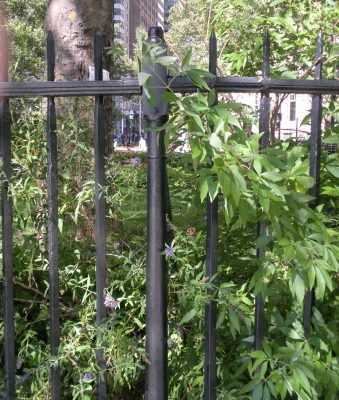
Near the end of Broadway is Bowling Green Park.  The fence that surrounds it is the original fence built in  1771, which makes it one of the oldest man-made structures in Manhattan:


After the tour, I walked around the neighborhood on my own. I got a bit lost, but eventually ended up on an overpass that looked out on the World Trade Center site. At this stage, it looked just like any ordinary construction site.

After walking along the overpass, and still on that same level, I ended up in a maze of buildings, eventually finding myself at the top of a marble staircase in what I later found out was the World Financial Center. Below was a huge glass-enclosed atrium filled with palm trees, which didn't seem like they belonged in New York!


Outside in the back, there were a whole bunch of tables overlooking a harbor. It was beautiful, and for once, the weather was perfect. I sat and relaxed, and finished reading a New Yorker story about Agatha Christie.


The setting, between the huge glass-domed atrium and the waterfront promenade, reminded me of a walk I had taken with my father about 25 years ago, on another segment of this promenade, and through another huge high-domed building (which I'm pretty sure was destroyed on 9/11). My father had been fascinated with the area, which at that time had a lot of new construction going on -- the twin towers themselves were relatively new -- with its maze of passageways hanging overhead in the air. (Editing to add: I just read that the Battery Park City area was built on landfill made from materials excavated when the Twin Towers were built.  So at the time of the walk with my father, that whole area must have been brand new -- and thus my father's interest.)

I went back out through the front of the building, and this time I knew where I was.  I went to take a closer look at a structure near the water, which I had seen in passing a couple of months ago. It looks like a park that is hanging in the air.


There were people walking on paths that wound through the greenery, but there was no immediately obvious way to get up there.  I started walking around the structure.  On the right side, there were long strips on the wall below the park.  The strips appeared blank, but as I walked past, words from quotations suddenly became visible, as if by magic.


The entrance was all the way in the back, on the side facing the river.  It was a sleek tunnel which gave no hint of the lush greenery soon to be encountered.


I had no idea what this place was until I got home and looked it up on the computer.  It's the Irish Hunger Memorial (photos, more photos, New Yorker, NY Times).

Thursday, September 2, 2010

Relief, after all

 Looks like there won't be much of a storm, but there will be lower temps and better air quality:
In New York City, the storm is expected to tread much lighter — sustained winds of up to 20 miles an hour and probably no more than a quarter of an inch of rain, the Weather Service says.

The low-pressure system is expected, however, to bring lower temperatures, and with them, relief to those suffering from the air quality index, which has hovered in the orange throughout the summer. That means that those who have trouble breathing — the elderly, or perhaps asthma sufferers — may have been affected by New York City’s air pollution. The index number is an aggregate of both the ozone and fine particulate counts in the air.

Wednesday, September 1, 2010

After this, the deluge?

I went for my walk around 8:30 at night. I wasn't the only one who had that idea -- the streets were filled with people trying to get in some exercise after the sun had gone down. It was still hot and muggy, and gigantic plastic bags of garbage were piled like an obstacle course on the sidewalks. Ah, New York, this is not you at your best.

I did manage, though, to get in the half hour of walking that I figure is the rock-bottom minimum daily exercise I need in order to stay alive.

When I got back there was a sign in the lobby saying we should take everything off of the terraces before the 100-mph hurricane hits on Friday or Saturday.

From what I had heard earlier on the news, the hurricane wasn't supposed to land here, so I thought the sign was just the building's usual over-abundance of caution.

But then I found this:

The National Hurricane Center warns that Hurricane Earl may swing by dangerously close to the U.S. East Coast before curving back out to sea. While the odds are it won't strike New York City directly, such an event is not unprecedented, and the city has plans in place to evacuate — and to hunker down — if need be.

It's always something.

It's too darned hot

I'm not going out until the sun goes down.

Soon, I'm going to be this guy:


Credit: That's a frame from a very funny cartoon by "The Oatmeal": Why working at home is both awesome and horrible

Tuesday, August 31, 2010

It's official -- this was New York City's hottest summer ever since they started keeping records

It was hot even when I was out at 9:00 PM tonight. I'm still not used to this weather. Maybe I never will be. In my old neighborhood in San Francisco, not far from the beach, no matter what the weather was like during the day, as soon as the sun went down, the fog would roll in, and the wind would start howling as if it were auditioning for a horror movie.

Now some guy on the TV is saying "... and the word is HOT" for tomorrow "... and the word is HOT" for Thursday.

The NY Times has an interesting article about the record-breaking heat. It says this summer was hotter than the 1966 summer, when 1,100 people died of the heat. Yikes! I haven't heard of anyone dying from the heat this summer, though. I think the difference was that 1966 must have had a lot of short, but extreme heat spikes (the Times said the temperature repeatedly exceeded 100 degrees), but this summer, while I don't think it ever broke 100, it was in the friggin' mid-90s day after day after day without relief.


Photo credit: "Twisted Sparkler 1" by Lars Sundstrom

Saturday, August 28, 2010

Pictures by Women: A History of Modern Photography -- at NY Museum of Modern Art

Went to the "Pictures by Women" show at the MoMA for the second time today.  The first time, I had just stumbled across it while I was looking for an exit.  It's a very exciting show!  Everything is from the museum's permanent collection and includes the work of some very famous names (Diane Arbus, Dorothea Lange, Cindy Sherman), but most of the photographers I hadn't heard of before.  I felt as if I had discovered a secret stash of buried treasure.


In this untitled 1973 photograph by Polish-born photographer Lucia Radonchonska, the girl in the foreground stares at the camera with an aggrieved expression.  Why?  Is she annoyed at the boy behind her?


"Untitled #92" by Cindy Sherman (1981).  When I entered the room where this photograph was hanging, even though the room was crowded with images, this one immediately grabbed my attention.  First off, it's huge.  Then there is something compelling about the expression in the woman's eyes (which are a vivid blue, a color echoed, slightly muted, in the shirt -- the picture here doesn't do the colors in the original justice) that's captivating, something about the way she is looking up and over.  The picture looks as if it could almost be a shot from a horror film, the way she is crouched down, as if she had recently been swiped by a blow from a mighty paw and now is watching the monster return.  Yet her expression is not terrified -- only wary.  The plaid skirt suggests a Catholic School uniform, but she is a grown woman.


"Walking House" by Laurie Simmons (1989). (The actual photograph consists only of the black-and-white house, legs, and leg shadows. Everything else is a reflection from my photo-of-the-photo. Sorry about that.) The artist, in the museum's audio program, said this photograph was one of a series she had done on objects with legs. She was inspired by a commercial she had seen when she was very young of a cigarette pack on legs dancing on a stage. The legs in this photo are actually only 3 or 4 inches high, and the house is a miniature from a model train set. The print as exhibited, though, is huge, I'd guess about seven feet tall. Simmons said that it was very important that the prints in this series be "human scale."


"Mother with Children Harlan County Kentucky" by Sheron Rupp (1990).  I was struck by the poverty in this photograph, with all the garbage in the background.  Yet this family is such a tight unit, with one holding the next holding the next, like a set of nested Russian matryoshka dolls.


"Revlon" by Elinor Carucci (1997).  This extreme close-up of an eyelash curler looks like a medieval torture device.


Another startling image by Cindy Sherman, this one of a woman who appears to be dead. (Apologies again for the reflections.) This is Untitled #153 (1985).


"Still Water (The River Themes, for Example)" by Roni Horn (1999) consists of four photographs with poetry in the form of footnotes at the bottom of each.  The combined effect is mesmerizing.  Here's a close-up of a section of the text from the photograph above:


The exhibit will have a very long run, through March 21, 2011.

For more info, see the MoMA page on the exhibit: Pictures by Women

Click through on the pictures for slightly larger versions.